
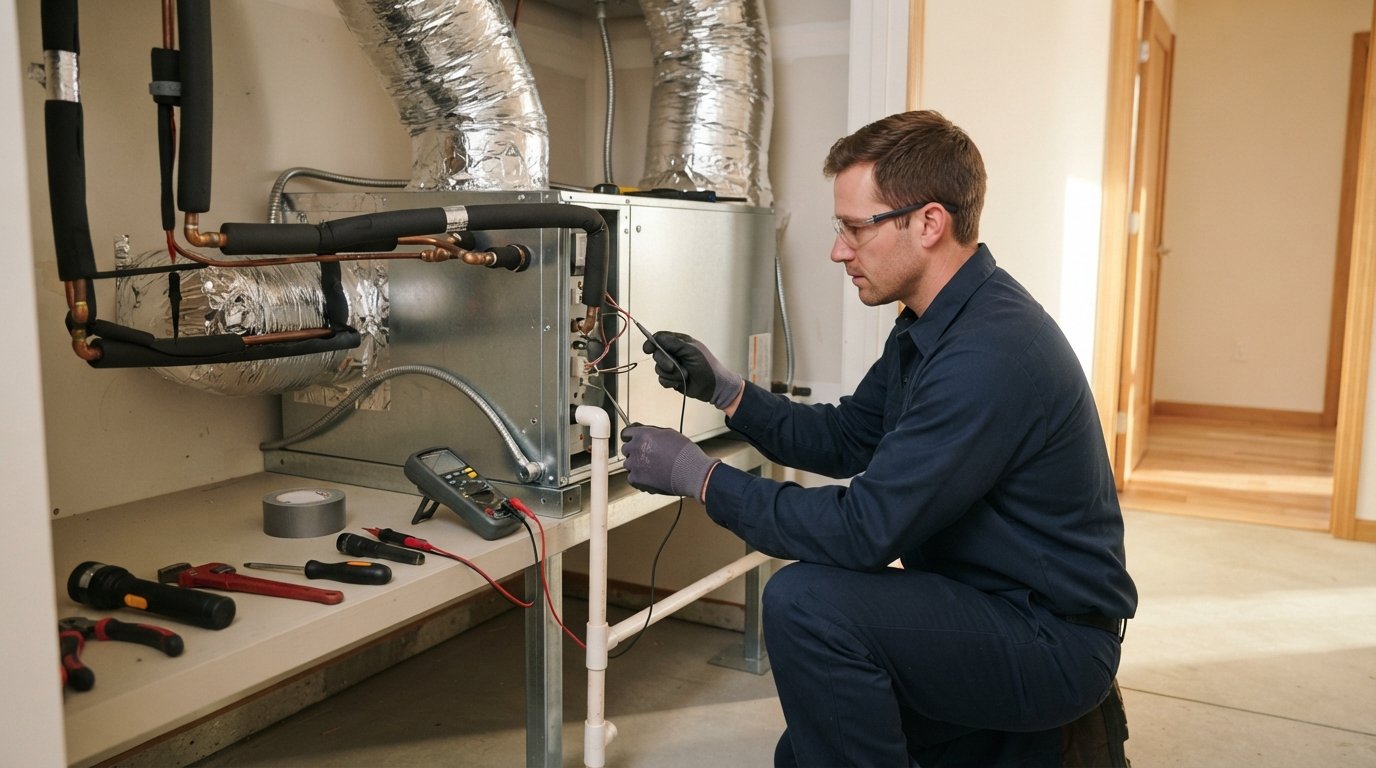
Air Handler Installation Cost Considerations for Homeowners
Air handler installation cost considerations explained: equipment, labor, ducts, and electrical work that shape your final quote and help you avoid surprise charges.

By Jackson Adams
Learn more about Central Air Conditioning Installation or Replacement for guides, costs, and what to expect.
Compare Central Air Conditioning Installation or Replacement Pros Near You

Enter your ZIP code to compare top-rated local professionals and request free quotes.
Your air handler is the quiet workhorse of your home's comfort system. It pulls air through the return ducts, filters it, conditions it, and pushes it back into every room. When that unit fails, the whole house feels it. What most homeowners do not realize until they start calling contractors is that the final invoice depends on far more than the price tag printed on a replacement box. Air handler installation cost considerations range from equipment efficiency ratings and labor rates to duct modifications, electrical upgrades, and whether you bundle the job with a new outdoor condenser. Understanding these variables before you request quotes is the single best way to avoid surprise charges and make a confident decision.
This guide breaks down the real drivers of air handler installation pricing, shows realistic cost ranges, and explains how to evaluate bids from multiple contractors. Whether you are in a Chicago bungalow with a cramped mechanical closet or a Florida ranch home with an attic-mounted unit, the same core factors apply. By the end, you will know exactly what questions to ask and where your money actually goes.
What an Air Handler Does and Why Replacement Costs Vary So Much
An air handler is the indoor half of a split HVAC system. It contains the blower motor, the evaporator coil, the filter rack, and the controls that regulate airflow through your home. In cooling season it works with the outdoor condenser to remove heat and humidity. In heating season, depending on your setup, it may pair with a heat pump, electric resistance strips, or a furnace section. Because it touches so many components, the installation quote reflects not just the box itself but the entire mechanical, electrical, and ductwork context around it.
Two homes with identical square footage can receive quotes that differ by thousands of dollars. One might have a wide, accessible closet with a clean plenum and a dedicated 240-volt circuit. The other might have a unit squeezed into a crawlspace with rusted flex duct, undersized wiring, and a drain pan that has been leaking for years. Contractors price the labor required, and labor is where the spread widens fastest. Equipment alone rarely explains the gap.
Another layer is timing. During a July heat wave, emergency replacement premiums can add 15 to 30 percent to a standard install. Scheduling in spring or fall, when HVAC crews are less slammed, often gives you more room to negotiate and more contractor availability. If your system is still running but aging, planning ahead is almost always cheaper than waiting for a mid-summer breakdown.
The Core Air Handler Installation Cost Considerations
When contractors build a quote, they are essentially pricing four categories: equipment, labor, materials, and site-specific modifications. Each one has its own variables, and each one can swing the final number significantly. Walking through them one by one helps you read a bid like a professional.
- Equipment cost: Standard efficiency units typically run $600 to $1,200, while high-efficiency variable-speed models can exceed $2,500 before installation.
- Labor cost: Skilled HVAC technicians charge $75 to $150 per hour, and a straightforward swap takes four to eight hours.
- Materials and consumables: Line sets, drain pans, float switches, sealants, and plenum transitions often add $200 to $600.
- Site modifications: Duct resizing, electrical circuit upgrades, platform rebuilding, and condensate routing can add $500 to $3,000 or more.
Equipment efficiency is the most visible cost lever. A 14.3 SEER2 unit meets current minimum standards and costs less upfront, but a 16 to 20 SEER2 variable-speed air handler can cut cooling costs noticeably in hot climates and qualifies for federal tax credits in many cases. The tradeoff is a higher purchase price and sometimes a required thermostat upgrade to communicate with the new blower. Homeowners planning to stay in the house for a decade usually recoup the difference through lower utility bills and fewer repair calls.
Labor varies by region, season, and complexity. A simple attic swap in a Texas suburb with wide decking might take half a day. A basement unit in an older Chicago home with limited clearance, asbestos-era duct wrap, and a tight electrical panel could take two technicians a full day or more. That is why comparing quotes from multiple local contractors matters so much: you are comparing how each one reads your specific site conditions.
Equipment Choices That Move the Price Up or Down
Not all air handlers are built the same, and the differences show up directly on your invoice. The biggest single decision is whether you choose a constant-speed blower or a variable-speed (also called inverter-driven) blower. Constant-speed units are cheaper and simpler. Variable-speed units ramp up and down gently, which means quieter operation, better humidity control, and often a longer lifespan because the motor is not starting and stopping at full power every cycle.
Coil type matters too. A standard copper coil costs less than a microchannel or aluminum coil, but the latter resists corrosion better in coastal environments such as Florida and the Gulf Coast. If you live within a few miles of saltwater, paying extra for a corrosion-resistant coil is not an upsell, it is a durability decision that can save you a premature replacement in five years.
Compatibility is another factor homeowners often overlook. If your outdoor condenser is a different brand or an older model, your contractor may need to install a matching coil or a TXV (thermostatic expansion valve) to make the system run correctly. Mismatched components can void manufacturer warranties and reduce efficiency, so a slightly higher quote that includes a matched coil is usually the better value. Ask each contractor to state plainly whether the quoted air handler is a matched set with your existing outdoor unit, or whether they recommend replacing both at once.
Labor, Access, and Site Conditions: The Hidden Cost Drivers
Access is the quietest but most consequential cost factor in air handler installation. A unit in a ground-floor utility closet with a clear path to the door is a dream job. A unit in a low attic with no walkway, or in a crawlspace accessible only through a hatch, turns a four-hour job into a full-day project with two technicians. Some contractors charge a flat rate per install, while others bill hourly, so the same physical job can produce very different quotes depending on which pricing model each company uses.
Ductwork condition is the next big variable. If the existing plenum and trunk lines are properly sized and sealed, the contractor can often reuse them. If the ducts are undersized, crushed, or leaking 20 percent of their air, the new air handler will underperform no matter how efficient it is. Many contractors will recommend duct sealing or partial replacement alongside the install, which can add $800 to $2,500 but is often essential for the system to deliver the comfort you are paying for.
Electrical service is the third hidden driver. Older homes sometimes have a 120-volt circuit feeding the air handler when the new unit requires 240 volts, or the panel may not have spare capacity. Upgrading a circuit, running new wire, or adding a subpanel can add several hundred to a few thousand dollars. A thorough contractor will check your panel and wiring during the estimate rather than discovering the issue on install day and handing you a change order.
For a deeper look at how airflow, duct design, and equipment selection interact, the guide on mastering air handler installation covers the technical side of efficient air distribution in more detail.
Typical Cost Ranges You Can Expect in 2026
National averages give you a baseline, but local labor markets shift these numbers meaningfully. In most U.S. markets, a straightforward air handler replacement with a standard-efficiency unit runs $1,800 to $3,500 installed. Mid-range high-efficiency units with variable-speed blowers typically land between $3,000 and $5,500. Premium installations that include duct modifications, electrical upgrades, or a matched coil replacement can reach $6,000 to $9,000 or more.
Regional patterns matter. In Texas and Florida, where cooling loads dominate and attic installs are common, labor rates are moderate but duct and insulation work often adds cost. In Chicago and the upper Midwest, basement and closet installs are more common, but older housing stock frequently requires electrical and duct updates. Coastal markets on both coasts tend to have the highest labor rates, sometimes 30 to 50 percent above the national average.
Emergency replacements after a breakdown almost always cost more. If your air handler fails in peak summer, you may pay a diagnostic fee, an after-hours premium, and a higher equipment price because the contractor is sourcing from limited local stock. Homeowners who replace proactively in shoulder seasons routinely save several hundred dollars compared to emergency buyers, and they get more contractor options to choose from.
How to Compare Quotes and Avoid Surprise Charges
The fastest way to protect your wallet is to request at least three itemized quotes. A good quote breaks out equipment model number, efficiency rating, labor hours, materials, permit fees, and any recommended duct or electrical work. A vague quote that lists only a lump sum gives you no way to compare value or spot missing scope.
During the estimate, ask each contractor to perform a load calculation (often called a Manual J) rather than simply matching the old unit's tonnage. Sizing by rule of thumb leads to oversized systems that short-cycle, dehumidify poorly, and wear out faster. A proper load calculation costs the contractor time, and a company willing to do it is signaling that it cares about long-term performance, not just closing the sale.
Also confirm what is included in the price. Ask specifically about:
- Permits and inspection fees (required in most jurisdictions for HVAC replacement).
- Old equipment removal and disposal.
- New drain pan, float switch, and condensate line flushing.
- Filter rack size and the first set of filters.
- Labor warranty length and manufacturer parts warranty registration.
Getting these answers in writing before work begins eliminates the most common source of disputes. If a contractor hesitates to itemize or pressures you to sign the same day, that is a signal to get another quote. Reputable companies expect you to comparison shop.
For homeowners who want a faster path to vetted professionals, platforms like USremodel connect you with independent contractors across the country, so you can gather multiple quotes for HVAC, roofing, windows, and other renovation projects without cold-calling dozens of companies.
Financing, Rebates, and Long-Term Value
Air handler replacement is rarely a planned expense, which is why financing options matter. Many HVAC contractors offer monthly payment plans through third-party lenders, often with promotional zero-interest periods for qualified buyers. Manufacturer rebates and federal tax credits for high-efficiency equipment can offset $300 to $2,000 depending on the unit's SEER2 rating and whether you pair it with a qualifying heat pump. Utility companies in many states add their own rebates on top.
Beyond the immediate cost, think about the total cost of ownership over the next ten to fifteen years. A high-efficiency variable-speed air handler typically costs more upfront but uses 20 to 40 percent less electricity than an older constant-speed unit. In a hot climate, that difference can add up to hundreds of dollars per year in savings, plus better humidity control and quieter operation. A well-installed unit also lasts longer, which pushes the next replacement further into the future.
The quality of the installation itself is the single biggest factor in how long your new air handler lasts. Correct refrigerant charge, proper airflow, sealed ducts, and a level drain pan matter more than the brand name on the box. That is why choosing a contractor with strong local references and a clear warranty policy is worth a modest premium over the lowest bid.
Before you commit, take one more pass through your home. Check the age of your outdoor condenser, the condition of your ducts, and the capacity of your electrical panel. The more you know going in, the better you can evaluate each quote and the less likely you are to face a mid-project surprise. A little preparation today turns a stressful repair into a smart, long-term investment in your home's comfort.